
 EN
EN



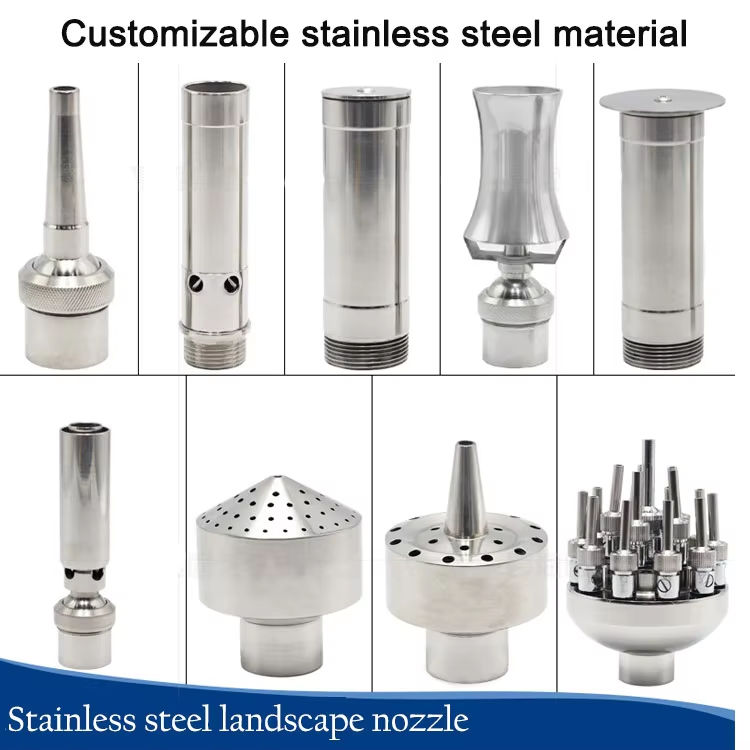
Superior Corrosion Resistance: How Stainless Steel Outlasts Plastic and Brass in Fountain Applications
The passive oxide layer: Science behind stainless steel’s corrosion resistance in chlorinated, saline, and hard-water environments
The reason stainless steel works so well for fountain nozzles has to do with this protective chromium oxide layer that actually repairs itself when exposed to oxygen. What makes this coating special is how it blocks those harmful ions from getting through, whether we're talking about chlorinated water found in most city fountains, salty air near coastal areas, or the tough mineral content in hard water. Brass nozzles tend to break down over time because of something called dezincification, while plastic ones just get all cracked and brittle after sitting out in sunlight and reacting with various chemicals. That's why Grade 316 stainless steel stands out. It gets an extra boost from molybdenum, which gives it great protection against pitting corrosion. This matters a lot for parts that stay underwater, since the acid from biofilms can really speed up corrosion in these spots.
| Material | Chlorine Resistance | Saltwater Performance | Hard Water Scaling | Expected Lifespan |
|---|---|---|---|---|
| Stainless Steel | Excellent (passive layer) | Superior (Mo-enhanced) | Minimal scaling | 15+ years |
| Brass | Moderate (dezincification risk) | Poor (rapid corrosion) | High scaling | 5–8 years |
| Plastic | Good (but degrades over time) | Brittle in UV/salt | Moderate scaling | 3–5 years |
Real-world validation: 10-year coastal fountain study – structural integrity and flow consistency of grade 316 fountain nozzles
Researchers looked at 120 fountain nozzles installed along coastal areas over ten years and found stainless steel holds up much better than other materials. Grade 316 stainless maintained nearly perfect flow rate accuracy at 98%, compared to only 74% for brass nozzles and a mere 63% for plastic ones. Even after years of exposure to salty air, there was no noticeable thinning of the stainless walls. Brass models started showing tiny cracks around the fourth year mark. The plastic versions had problems too - they warped under UV light from the sun, changing how water sprayed out as soon as year three rolled around. For anyone running misting systems or aerators near the beach, this matters a lot. Stainless steel doesn't change shape when stressed by weather conditions, so it keeps delivering water consistently regardless of what Mother Nature throws at it.
Environmental Resilience: UV Stability, Thermal Cycling, and Biofilm Resistance in Stainless Steel Fountain Nozzles
UV resistance and thermal stability across nozzle types (jet, stream, ball) – no degradation in aesthetics or function
Fountain nozzles made from stainless steel keep working well even when exposed to harsh weather conditions. Polymers tend to turn yellow, develop cracks, and weaken over time when hit by sunlight, but stainless steel actually bounces back solar rays which helps it look good and maintain its shape for many years. When temperatures swing wildly between freezing cold and blazing hot days, brass components start to bend out of shape while plastic parts become brittle. Stainless steel handles these temperature changes much better thanks to its low expansion rate around 17 micrometers per meter per degree Celsius. Real world tests show that these nozzles don't deform at all after going through thousands of freeze-thaw cycles between minus 20 degrees and plus 60 degrees Celsius. This means fountain operators can expect consistent water displays without needing constant adjustments or replacements.
Hardness, pitting resistance, and biofilm resilience: Why stainless steel fountain nozzles maintain performance in variable water quality
Grade 316 stainless steel is pretty hard stuff, with a hardness rating of at least 150 HV, which means it stands up well against erosion caused by those tiny sediment particles floating around in fountain water that circulates through systems. This kind of wear is actually one of the main reasons why softer materials tend to fail early on. When looking at pitting resistance, Grade 316 scores quite high with a PREN value over 25. That makes it much better at fighting off corrosion from chlorides compared to regular brass. We're talking about service life that can last up to eight times longer in places near saltwater or where chemical treatments are used regularly. Another big plus is how smooth the surface finish is, typically below 0.8 micrometers roughness average. Peer reviewed research indicates this smoothness helps keep bacteria away, showing about 70% fewer colonies forming compared to rougher alternatives. The result? Less buildup of those pesky microbial mats that restrict water flow. All these properties work together so the system maintains good hydraulic performance even when dealing with water that varies between pH levels 5 and 9, or has high concentrations of dissolved solids above 1,000 parts per million.
Consistent Hydraulic Performance: Misting, Stream, and Volume Delivery Across Time and Conditions
Stainless steel fountain nozzles keep performing reliably for many years, maintaining their mist patterns, stream shapes, and water output levels no matter what the season brings or how the water chemistry changes over time. Brass and plastic options tell a different story though. These materials tend to break down gradually from things like sun damage, mineral deposits building up inside them, or getting worn out by heat cycles. Stainless steel doesn't have these problems because its surface just doesn't react much with anything in the environment. Looking at industry data, we see stainless steel nozzles lose less than 1% efficiency each year while plastic ones start showing drops between 4% and 7% after just five years of service. This kind of stability matters a lot when creating those beautiful water displays people love to watch. Even small changes in water flow can mess up the look completely in features like smooth arcs or bubbly sprays. Fountain designers know this well. They prefer stainless steel not because it's trendy but because it works day after day without needing constant attention or replacement costs eating into budgets.
FAQ
Why is stainless steel preferred in fountain applications?
Stainless steel is preferred due to its superior corrosion resistance, longevity, and stability under various environmental conditions such as UV exposure, thermal cycling, and biofilm presence. It maintains performance over time, unlike plastic and brass, which degrade more quickly.
What makes Grade 316 stainless steel ideal for coastal areas?
Grade 316 stainless steel contains molybdenum, providing extra protection against the aggressive pitting corrosion often seen in coastal, salty environments. This makes it ideal for coastal fountain applications where materials are constantly exposed to harsh conditions.
How does stainless steel compare to brass and plastic in terms of lifespan?
Stainless steel, especially Grade 316, offers a lifespan of over 15 years with minimal scaling and corrosion issues. In contrast, brass and plastic have shorter lifespans of 5–8 years and 3–5 years, respectively, due to higher rates of degradation and environmental wear.
Can stainless steel fountain nozzles withstand extreme temperatures?
Yes, stainless steel nozzles are designed to handle extreme temperatures and temperature fluctuations without deforming, thanks to their low expansion rate. They remain functional and maintain performance through thousands of freeze-thaw cycles.
Table of Contents
- Superior Corrosion Resistance: How Stainless Steel Outlasts Plastic and Brass in Fountain Applications
- Environmental Resilience: UV Stability, Thermal Cycling, and Biofilm Resistance in Stainless Steel Fountain Nozzles
- Consistent Hydraulic Performance: Misting, Stream, and Volume Delivery Across Time and Conditions
- FAQ